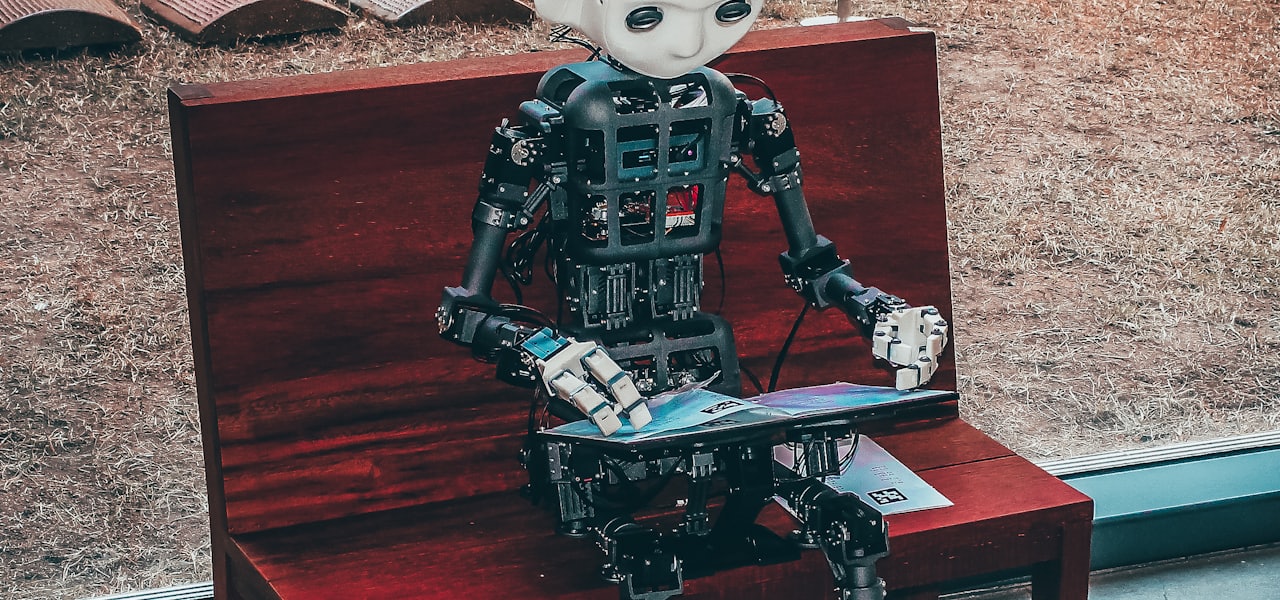
Organoid intelligence (OI) is an emerging field of study in computer science and biology that develops and studies biological wetware computing using 3D cultures of human brain cells (or brain organoids) and brain-machine interface technologies. Such technologies may be referred to as OIs or the nervous filesystem. Organoid intelligent computer systems can be an example of biohybrid systems. == Differences with non-organic computing == As opposed to traditional non-organic silicon-based approaches, OI seeks to use lab-grown cerebral organoids to serve as "biological hardware". While these structures are still far from being able to think like a regular human brain and do not yet possess strong computing capabilities, OI research currently offers the potential to improve the understanding of brain development, learning and memory, potentially finding treatments for neurological disorders such as dementia. Thomas Hartung, a professor from Johns Hopkins University, argued in 2023 that "while silicon-based computers are certainly better with numbers, brains are better at learning." He noted that transistor density in computer chip may be approaching its limits, whereas brains, being wired differently, are more energy-efficient and can store large amounts of information. Some researchers claim that even though human brains are slower than machines at processing simple information, they are far better at processing complex information as brains can deal with fewer and more uncertain data, perform both sequential and parallel processing, being highly heterogenous, use incomplete datasets, and is said to outperform non-organic machines in decision-making. Training OIs involve the process of biological learning (BL) as opposed to machine learning (ML) for AIs. == Bioinformatics in OI == OI generates complex biological data, necessitating sophisticated methods for processing and analysis. Bioinformatics provides the tools and techniques to decipher raw data, uncovering the patterns and insights. Researchers have developed a platform named Neuroplatform for experimenting remotely with brain organoids via an API. == Intended functions == Brain-inspired computing hardware aims to emulate the structure and working principles of the brain and could be used to address current limitations in AI technologies. However, brain-inspired silicon chips are still limited in their ability to fully mimic brain function, as most examples are built on digital electronic principles. One study performed OI computation (which they termed Brainoware) by sending and receiving information from the brain organoid using a high-density multielectrode array. By applying spatiotemporal electrical stimulation, nonlinear dynamics, and fading memory properties, as well as unsupervised learning from training data by reshaping the organoid functional connectivity, the study showed the potential of this technology by using it for speech recognition and nonlinear equation prediction in a reservoir computing framework. == Ethical concerns == While researchers are hoping to use OI and biological computing to complement traditional silicon-based computing, there are also questions about the ethics of such an approach. Concerns include the possibility that an organoid could develop sentience or consciousness, and the question of the relationship between a stem cell donor (for growing the organoid) and the respective OI system.
Insider threat
An insider threat is a perceived threat to an organization that comes from people within the organization, such as employees, former employees, contractors or business associates, who have inside information concerning the organization's security practices, data and computer systems. The threat may involve fraud, the theft of confidential or commercially valuable information, the theft of intellectual property, or the sabotage of computer systems. == Overview == Insiders may have accounts giving them legitimate access to computer systems, with this access originally having been given to them to serve in the performance of their duties; these permissions could be abused to harm the organization. Insiders are often familiar with the organization's data and intellectual property as well as the methods that are in place to protect them. This makes it easier for the insider to circumvent any security controls of which they are aware. Physical proximity to data means that the insider does not need to hack into the organizational network through the outer perimeter by traversing firewalls; rather they are in the building already, often with direct access to the organization's internal network. Insider threats are harder to defend against than attacks from outsiders, since the insider already has legitimate access to the organization's information and assets. An insider may attempt to steal property or information for personal gain or to benefit another organization or country. The threat to the organization could also be through malicious software left running on its computer systems by former employees, a so-called logic bomb. == Research == Insider threat is an active area of research in academia and government. The CERT Coordination Center at Carnegie-Mellon University maintains the CERT Insider Threat Center, which includes a database of more than 850 cases of insider threats, including instances of fraud, theft and sabotage; the database is used for research and analysis. CERT's Insider Threat Team also maintains an informational blog to help organizations and businesses defend themselves against insider crime. The Threat Lab and Defense Personnel and Security Research Center (DOD PERSEREC) has also recently emerged as a national resource within the United States of America. The Threat Lab hosts an annual conference, the SBS Summit. They also maintain a website that contains resources from this conference. Complimenting these efforts, a companion podcast was created, Voices from the SBS Summit. In 2022, the Threat Lab created an interdisciplinary journal, Counter Insider Threat Research and Practice (CITRAP) which publishes research on insider threat detection. === Findings === In the 2022 Data Breach Investigations Report (DBIR), Verizon found that 82% of breaches involved the human element, noting that employees continue to play a leading role in cybersecurity incidents and breaches. According to the UK Information Commissioners Office, 90% of all breaches reported to them in 2019 were the result of mistakes made by end users. This was up from 61% and 87% over the previous two years. A 2018 whitepaper reported that 53% of companies surveyed had confirmed insider attacks against their organization in the previous 12 months, with 27% saying insider attacks have become more frequent. A report published in July 2012 on the insider threat in the U.S. financial sector gives some statistics on insider threat incidents: 80% of the malicious acts were committed at work during working hours; 81% of the perpetrators planned their actions beforehand; 33% of the perpetrators were described as "difficult" and 17% as being "disgruntled". The insider was identified in 74% of cases. Financial gain was a motive in 81% of cases, revenge in 23% of cases, and 27% of the people carrying out malicious acts were in financial difficulties at the time. The US Department of Defense Personnel Security Research Center published a report that describes approaches for detecting insider threats. Earlier it published ten case studies of insider attacks by information technology professionals. Cybersecurity experts believe that 38% of negligent insiders are victims of a phishing attack, whereby they receive an email that appears to come from a legitimate source such as a company. These emails normally contain malware in the form of hyperlinks. == Typologies and ontologies == Multiple classification systems and ontologies have been proposed to classify insider threats. Traditional models of insider threat identify three broad categories: Malicious insiders, which are people who take advantage of their access to inflict harm on an organization; Negligent insiders, which are people who make errors and disregard policies, which place their organizations at risk; and Infiltrators, who are external actors that obtain legitimate access credentials without authorization. == Criticisms == Insider threat research has been criticized. Critics have argued that insider threat is a poorly defined concept. Forensically investigating insider data theft is notoriously difficult, and requires novel techniques such as stochastic forensics. Data supporting insider threat is generally proprietary (i.e., encrypted data). Theoretical/conceptual models of insider threat are often based on loose interpretations of research in the behavioral and social sciences, using "deductive principles and intuitions of subject matter expert." Adopting sociotechnical approaches, researchers have also argued for the need to consider insider threat from the perspective of social systems. Jordan Schoenherr said that "surveillance requires an understanding of how sanctioning systems are framed, how employees will respond to surveillance, what workplace norms are deemed relevant, and what ‘deviance’ means, e.g., deviation for a justified organization norm or failure to conform to an organizational norm that conflicts with general social values." By treating all employees as potential insider threats, organizations might create conditions that lead to insider threats. == Sector-specific concerns == === Healthcare === The healthcare industry faces particularly acute insider threat risks due to the large number of workforce members who require access to sensitive patient records for legitimate clinical purposes. The U.S. Department of Health and Human Services has identified unauthorized access by insiders, including workforce snooping on patient records and theft of protected health information for identity fraud, as a persistent enforcement concern. The Health Insurance Portability and Accountability Act (HIPAA) Security Rule addresses insider threats through several administrative safeguards, including workforce security procedures requiring covered entities to implement policies for authorizing and supervising workforce members who work with electronic protected health information, as well as termination procedures to revoke access when employment ends (45 CFR 164.308(a)(3)). The rule also requires audit controls to record and examine information system activity (45 CFR 164.312(b)), enabling detection of unauthorized access by insiders. The December 2024 Notice of proposed rulemaking (NPRM) to overhaul the HIPAA Security Rule would strengthen insider threat defenses by mandating role-based access controls, requiring notification of relevant workforce members within 24 hours of any changes to access privileges, and requiring regular review of audit logs to detect anomalous access patterns.
Radar geo-warping
Radar geo-warping is the adjustment of geo-referenced radar images and video data to be consistent with a geographical projection. This image warping avoids any restrictions when displaying it together with video from multiple radar sources or with other geographical data including scanned maps and satellite images which may be provided in a particular projection. There are many areas where geo warping has unique benefits: Single radar video signal displayed together with maps of different geographical projections. E.g. Mercator UTM stereographic Multiple radar video signals displayed simultaneously: Having the computing power to do so on one computer. Adapting the projection of all radar signals allowing the geographically correct display and accurate superimposition of those videos. Slant range correction: a modern 3D radar system can measure the height of a target and hence it is possible to correct the radar video by the real corrected range of the target. Slant Range Correction also allows to compensate the radar tower height e.g. for maritime surveillance radars. == Introduction == Radar video presents the echoes of electromagnetic waves a radar system has emitted and received as reflections afterwards. These echoes are typically presented on a computer screen with a color-coding scheme depicting the reflection strength. Two problems have to be solved during such a visualization process. The first problem arises from the fact that typically the radar antenna turns around its position and measures the reflection echo distances from its position in one direction. This effectively means that the radar video data are present in polar coordinates. In older systems the polar oriented picture has been displayed in so called plan position indicators (PPI). The PPI-scope uses a radial sweep pivoting about the center of the presentation. This results in a map-like picture of the area covered by the radar beam. A long-persistence screen is used so that the display remains visible until the sweep passes again. Bearing to the target is indicated by the target's angular position in relation to an imaginary line extending vertically from the sweep origin to the top of the scope. The top of the scope is either true north (when the indicator is operated in the true bearing mode) or ship's heading (when the indicator is operated in the relative bearing mode). For visualization on a modern computer screen the polar coordinates have to be converted into Cartesian coordinates. This process called radar scan conversion is presented with more detail in the next section. The second problem to solve arises from the fact that a radar system is placed in the real world and measures real world echo positions. These echoes have to be displayed together with other real world data like object positions, vector maps and satellite images in a consistent way. All this information refers to the curved earth surface but is displayed on a flat computer display. Building a link from real world earth positions to display pixels is commonly called geographical referencing or in short geo-referencing. Part of the geo-referencing process is to map the 3D earth surface onto a 2D display. This process of a geographical projection can be performed in many ways, but different data sources have their own 'natural' projection. E.g. Cartesian radar video data from a radar source on the earth surface are geo-referenced by a so-called radar projection. When using this radar projection the Cartesian radar video pixels can directly displayed on a computer screen (only being linearly transformed according to the current position on the screen and e.g. the current zoom level). A problem now arises if e.g. also a satellite map shall be shown together with the radar video data. The 'natural' geographical projection of a satellite image would be a satellite projection which depends on the satellite orbit, position and further parameters. Now either the satellite image has to be reprojected to a radar projection or the radar video has to use the satellite projection. This geographical re-projection is also called geographical warping or Geo Warping where each image pixel has to be transformed from one projection into another. This article describes in further detail the Geo Warping of radar video images in real time. It will also show that radar video Geo Warping is done most efficiently when it is integrated with the radar scan conversion process. == Radar-scan conversion == This section describes the principles of the radar-scan conversion (RSC) process. The radar supplies its measured data in polar coordinates (ρ,θ) directly from the rotating antenna. ρ defines the target/echo distance and θ the target angle in polar world coordinates. These data are measured, digitized and stored in a polar coordinate polar store or polar pixmap. The main RSC task is to convert these data to Cartesian (x, y) display coordinates, creating the necessary display pixels. The RSC process is influenced by the current zoom, shift and rotation settings defining which part of the 'world' shall be visible in the display image. As detailed later the RSC process also takes the currently used geographical projection into account when the radar video images are Geo Warped. The OpenGL RSC is implemented using a reverse scan conversion approach which calculates for every image pixel the most appropriate radar amplitude value in the polar store. This approach generates an optimal image without any artifacts known from forward spoke fill algorithms. By applying bi-linear filtering between adjacent pixels in the polar store during the conversion process the OpenGL RSC finally achieves a very high visual quality radar display image for every zoom level, creating smooth images of the radar echoes. == Radar projection == This section illustrates how radar video data are geo referenced and displayed on a computer screen. The radar sensor is positioned on the earth surface with a height h above the ground. It measures the direct distance d to the target (and not e.g. the distance the target is away from the radar if one would move on the earth surface). This distance is then used in the display plane after adjustment to the current display zoom level by the radar scan converter (RSC). Now it has to be clarified how the radar video data is geo referenced. This basically means, that if we want to display a geographical real world object (like e.g. a light house) which is at the same real world position as the radar target, that it also shall appear at the same position in the display plane. This is realized by calculating the distance from the radar sensor to the respective real world object and use that distance in the display plane. The position of the real world object is typically given in geographical coordinates (latitude, longitude and height above the earth surface). In other words, using a radar projection with geographical data is done by simulating a radar measurement process with the real world objects and use the resulting range and azimuth in the display plane. The second picture to the right shows an example radar projection with the center of projection (COP) at latitude 50.0° and longitude 0.0° which is also the radar position. The dashed lines are the equal-latitude and equal-longitude lines on top of the background map. The solid lines show equal-range and equal-azimuth with the respect to the radar position. It is a feature of the radar projection that equal-range lines are circles and equal-azimuth lines are straight lines. This is necessary to display radar video consistently with other map data when using a radar projection where the projection center has to be the radar position. == Geo Warping process == This section explains the actual geo warping or re-projection process when applied to radar video in real time. Assume we want to display radar video on top of a satellite image. As an example we use the CIB projection which is used to display satellite data in CIB (Controlled Image Base) format. The Figure Geo Warping Radar to CIB Projection shows dashed the maximal range circle for a range of 111 km or 60 miles using the radar projection. Such a range is typical for long range coastal surveillance radars. As stated in the last section this is a perfect circle also on the computer screen. The solid line ellipse shows the same range circle for the CIB projection. Typically the errors occurring without Geo Warping are smallest near the radar position if at least the projection center (COP) coincides with the radar position, as realized in our example. Otherwise the error distribution depends both on the used projection and also on the projection parameters. Thus, in our case the errors are most significant near the maximum radar range. The CIB projection error corrected in east–west direction at half the radar range is 2.6 km and is 5.3 km at the full radar range of 111 km. An error of 5.3 km is
Frameserver
A frameserver is any program that acts as a media source in the process called frameserving, which transfers digital video data from one computer program to another without intermediate files. The program that receives the data – the frameclient – could be any type of video application. The process is controlled by the frameclient: the frameclient requests audio/video frames and the frameserver serves them. The client can request frames in any order, allowing it to pause or jump to an arbitrary frame, just as a media player does with a file on disk. The client is most commonly a media encoder, a non-linear editing system, or a media player. == Frameservers == AviSynth VirtualDub VapourSynth Debugmode FrameServer
LENA Foundation
The LENA Foundation is an American nonprofit organisation which provides tools for measuring children's language acquisition and exposure. Specifically, the LENA system consists of a digital language processor which is worn by a child and records and analyses their auditory environment, using propriety software. It then presents a summary of child-adult conversation, such as conversation turns and word counts. The purpose of the LENA system is to encourage interactive talk between children (between the age of two to forty-eight months) and their caretakers. The LENA system is also used for research; while useful for researchers who wish to save transcription costs or observe the child in its natural state, the accuracy of this system, while often quite high, varies between contexts, for example notably in the case of hard of hearing children. Because of this, several researchers recommend caution in using only the LENA system on its own for the purposes of scientific research. == History == The LENA Foundation was established in 2009 by Terrance and Judith Paul, founders of Renaissance Learning, Inc., with the purpose of aiding children with disabilities and assisting with early learning. They were inspired by the book "Meaningful Differences in the Everyday Experience of American Children" by Dr. Betty Hart and Dr. Todd Risley. A pilot version of the LENA system was launched in February 2006. The LENA Research Foundation was registered as a tax-exempt 501(c)(3) nonprofit in September 2010. The organisation was renamed simply LENA in 2018 and adopted the tagline "Building brains through early talk." LENA has been used for parental feedback, linguistics or paediatrics research, and for specific clinical cases. == Scientific background == In 2018, research using the LENA system showed that there was a link between children's conversational turns and activation of Broca's area (a part of the brain responsible, although not necessarily essential, for language processing). The LENA foundation cites research by its own employees as evidence for the scientific basis of its technology. Said research claims that verbal interaction with young children has an effect on language acquisition, including verbal comprehension skills during adolescence. == LENA System == The LENA software analyses a child's natural language environment, such as verbal exposure, and provides several metrics, such as adult and child speech time, television/recorded audio time, word count, or conversation turn count. The LENA hardware is a recorder that is usually placed into a child's specially-designed vest. The software was trained on over 65,000 hours of manually annotated American English audio recordings. It splits the audio into segments which are categorised as "key child", "other child", "male adult", "noise", etc. The advantages of LENA as opposed to manual transcription are its speed and ease of use; the disadvantages are its potential inaccuracies and lack of transcription capability (which LENA does not profess to attempt). The LENA system has also been criticised for prioritising quantity of speaking over quality (i.e., mastery of the language, as opposed to babble). == Product lines == === LENA Start === LENA Start is a program for parents that utilises feedback from the LENA System in conjunction with weekly group sessions in order to address the home language environment. It was introduced in 2015 and implemented across several U.S. states. In October 2020, during the restrictions of the COVID-19 pandemic, Read Aloud Delaware began a virtual LENA Start program with families statewide, where parents received feedback and participated in one-hour Zoom workshops each week during the 10-week program. === LENA Grow === LENA Grow is a professional development program for teachers in early childhood classrooms. Before launching at sites around the country, the program was first piloted in Escambia County, Florida. === LENA Home === LENA Home is a supplement to existing parent coaching curricula. Typically, home visitors facilitate the use of the LENA System to help parents track their progress towards increasing interactive talk in their homes. === Developmental Snapshot === The LENA Developmental Snapshot, based on a 52-question parent survey, assesses both expressive and receptive language skills and provides an estimate of a child's developmental age from 2 months to 36 months.
Quantum artificial life
Quantum artificial life is the application of quantum algorithms with the ability to simulate biological behavior. Quantum computers offer many potential improvements to processes performed on classical computers, including machine learning and artificial intelligence. Artificial intelligence applications are often inspired by the idea of mimicking human brains through closely related biomimicry. This has been implemented to a certain extent on classical computers (using neural networks), but quantum computers offer many advantages in the simulation of artificial life. Artificial life and artificial intelligence are extremely similar, with minor differences; the goal of studying artificial life is to understand living beings better, while the goal of artificial intelligence is to create intelligent beings. In 2016, Alvarez-Rodriguez et al. developed a proposal for a quantum artificial life algorithm with the ability to simulate life and Darwinian evolution. In 2018, the same research team led by Alvarez-Rodriguez performed the proposed algorithm on the IBM ibmqx4 quantum computer, and received optimistic results. The results accurately simulated a system with the ability to undergo self-replication at the quantum scale. == Artificial life on quantum computers == The growing advancement of quantum computers has led researchers to develop quantum algorithms for simulating life processes. Researchers have designed a quantum algorithm that can accurately simulate Darwinian Evolution. Since the complete simulation of artificial life on quantum computers has only been actualized by one group, this section shall focus on the implementation by Alvarez-Rodriguez, Sanz, Lomata, and Solano on an IBM quantum computer. Individuals were realized as two qubits, one representing the genotype of the individual and the other representing the phenotype. The genotype is copied to transmit genetic information through generations, and the phenotype is dependent on the genetic information as well as the individual's interactions with their environment. In order to set up the system, the state of the genotype is instantiated by some rotation of an ancillary state ( | 0 ⟩ ⟨ 0 | {\displaystyle |0\rangle \langle 0|} ). The environment is a two-dimensional spatial grid occupied by individuals and ancillary states. The environment is divided into cells that are able to possess one or more individuals. Individuals move throughout the grid and occupy cells randomly; when two or more individuals occupy the same cell they interact with each other. === Self replication === The ability to self-replicate is critical for simulating life. Self-replication occurs when the genotype of an individual interacts with an ancillary state, creating a genotype for a new individual; this genotype interacts with a different ancillary state in order to create the phenotype. During this interaction, one would like to copy some information about the initial state into the ancillary state, but by the no cloning theorem, it is impossible to copy an arbitrary unknown quantum state. However, physicists have derived different methods for quantum cloning which does not require the exact copying of an unknown state. The method that has been implemented by Alvarez-Rodriguez et al. is one that involves the cloning of the expectation value of some observable. For a unitary U {\displaystyle U} which copies the expectation value of some set of observables X {\displaystyle {\mathsf {X}}} of state ρ {\displaystyle \rho } into a blank state ρ e {\displaystyle \rho _{e}} , the cloning machine is defined by any ( U , ρ e , X ) {\displaystyle (U,\rho _{e},{\mathsf {X}})} that fulfill the following: ∀ ρ ∀ X ∈ X {\displaystyle \forall \rho \forall X\in {\mathsf {X}}} X ¯ = X 1 ¯ = X 2 ¯ {\displaystyle {\bar {X}}={\bar {X_{1}}}={\bar {X_{2}}}} Where X ¯ {\displaystyle {\bar {X}}} is the mean value of the observable in ρ {\displaystyle \rho } before cloning, X 1 ¯ {\displaystyle {\bar {X_{1}}}} is the mean value of the observable in ρ {\displaystyle \rho } after cloning, and X 2 ¯ {\displaystyle {\bar {X_{2}}}} is the mean value of the observable in ρ e {\displaystyle \rho _{e}} after cloning. Note that the cloning machine has no dependence on ρ {\displaystyle \rho } because we want to be able to clone the expectation of the observables for any initial state. It is important to note that cloning the mean value of the observable transmits more information than is allowed classically. The calculation of the mean value is defined naturally as: X ¯ = T r [ ρ X ] {\displaystyle {\bar {X}}=Tr[\rho X]} , X 1 ¯ = T r [ R X ⊗ I ] {\displaystyle {\bar {X_{1}}}=Tr[RX\otimes I]} , X 2 ¯ = T r [ R I ⊗ X ] {\displaystyle {\bar {X_{2}}}=Tr[RI\otimes X]} where R = U ρ ⊗ ρ e U † {\displaystyle R=U\rho \otimes \rho _{e}U^{\dagger }} The simplest cloning machine clones the expectation value of σ z {\displaystyle \sigma _{z}} in arbitrary state ρ = | ψ ⟩ ⟨ ψ | {\displaystyle \rho =|\psi \rangle \langle \psi |} to ρ e = | 0 ⟩ ⟨ 0 | {\displaystyle \rho _{e}=|0\rangle \langle 0|} using U = C N O T {\displaystyle U=CNOT} . This is the cloning machine implemented for self-replication by Alvarez-Rodriguez et al. The self-replication process clearly only requires interactions between two qubits, and therefore this cloning machine is the only one necessary for self replication. === Interactions === Interactions occur between individuals when the two take up the same space on the environmental grid. The presence of interactions between individuals provides an advantage for shorter-lifespan individuals. When two individuals interact, exchanges of information between the two phenotypes may or may not occur based on their existing values. When both individual's control qubits (genotypes) are alike, no information will be exchanged. When the control qubits differ, the target qubits (phenotype) will be exchanged between the two individuals. This procedure produces a constantly changing predator-prey dynamic in the simulation. Therefore, long-living qubits, with a larger genetic makeup in the simulation, are at a disadvantage. Since information is only exchanged when interacting with an individual of different genetic makeup, the short-lived population has the advantage. === Mutation === Mutations exist in the artificial world with limited probability, equivalent to their occurrence in the real world. There are two ways in which the individual can mutate: through random single qubit rotations and by errors in the self-replication process. There are two different operators that act on the individual and cause mutations. The M operation causes a spontaneous mutation within the individual by rotating a single qubit by parameter θ. The parameter θ is random for each mutation, which creates biodiversity within the artificial environment. The M operation is a unitary matrix which can be described as: M = ( cos ( θ ) s i n ( θ ) s i n ( θ ) − c o s ( θ ) ) {\displaystyle M={\begin{pmatrix}\cos(\theta )&sin(\theta )\\sin(\theta )&-cos(\theta )\end{pmatrix}}} The other possible way for mutations to occur is due to errors in the replication process. Due to the no-cloning theorem, it is impossible to produce perfect copies of systems that are originally in unknown quantum states. However, quantum cloning machines make it possible to create imperfect copies of quantum states, in other words, the process introduces some degree of error. The error that exists in current quantum cloning machines is the root cause for the second kind of mutations in the artificial life experiment. The imperfect cloning operation can be seen as: U M ( θ ) = I 4 + 1 2 ( 0 0 0 1 ) ⊗ ( − 1 1 1 − 1 ) ( c o s θ + i s i n θ + 1 ) {\displaystyle U_{M}(\theta )=\mathrm {I} _{4}+{\frac {1}{2}}{\begin{pmatrix}0&0\\0&1\end{pmatrix}}\otimes {\begin{pmatrix}-1&1\\1&-1\end{pmatrix}}(cos\theta +isin\theta +1)} The two kinds of mutations affect the individual differently. While the spontaneous M operation does not affect the phenotype of the individual, the self-replicating error mutation, UM, alters both the genotype of the individual, and its associated lifetime. The presence of mutations in the quantum artificial life experiment is critical for providing randomness and biodiversity. The inclusion of mutations helps to increase the accuracy of the quantum algorithm. === Death === At the instant the individual is created (when the genotype is copied into the phenotype), the phenotype interacts with the environment. As time evolves, the interaction of the individual with the environment simulates aging which eventually leads to the death of the individual. The death of an individual occurs when the expectation value of σ z {\displaystyle \sigma _{z}} is within some ϵ {\displaystyle \epsilon } of 1 in the phenotype, or, equivalently, when ρ p = | 0 ⟩ ⟨ 0 | {\displaystyle \rho _{p}=|0\rangle \langle 0|} The Lindbladian describes the interaction of the individual with the environment: ρ
Steerable filter
In image processing, a steerable filter is an orientation-selective filter that can be computationally rotated to any direction. Rather than designing a new filter for each orientation, a steerable filter is synthesized from a linear combination of a small, fixed set of "basis filters". This approach is efficient and is widely used for tasks that involve directionality, such as edge detection, texture analysis, and shape-from-shading. The principle of steerability has been generalized in deep learning to create equivariant neural networks, which can recognize features in data regardless of their orientation or position. == Example == A common example of a steerable filter is the first derivative of a two-dimensional Gaussian function. This filter responds strongly to oriented image features like edges. It is constructed from two basis filters: the partial derivative of the Gaussian with respect to the horizontal direction ( x {\displaystyle x} ) and the vertical direction ( y {\displaystyle y} ). If G ( x , y ) {\displaystyle G(x,y)} is the Gaussian function, and G x {\displaystyle G_{x}} and G y {\displaystyle G_{y}} are its partial derivatives (which measure the rate of change in the x {\displaystyle x} and y {\displaystyle y} directions, respectively), a new filter G θ {\displaystyle G_{\theta }} oriented at an angle θ {\displaystyle \theta } can be synthesized with the formula: G θ = cos ( θ ) G x + sin ( θ ) G y {\displaystyle G_{\theta }=\cos(\theta )G_{x}+\sin(\theta )G_{y}} Here, the basis filters G x {\displaystyle G_{x}} and G y {\displaystyle G_{y}} are weighted by cos ( θ ) {\displaystyle \cos(\theta )} and sin ( θ ) {\displaystyle \sin(\theta )} to "steer" the filter's sensitivity to the desired orientation. This is equivalent to taking the dot product of the direction vector ( cos θ , sin θ ) {\displaystyle (\cos \theta ,\sin \theta )} with the filter's gradient, ( G x , G y ) {\displaystyle (G_{x},G_{y})} . == Generalization in deep learning: Equivariant neural networks == The concept of steerability is foundational to equivariant neural networks, a class of models in deep learning designed to understand symmetries in data. A network is considered equivariant to a transformation (like a rotation) if transforming the input and then passing it through the network produces the same result as passing the input through the network first and then transforming the output. Formally, for a transformation T {\displaystyle T} and a network f {\displaystyle f} , this property is defined as f ( T ( input ) ) = T ( f ( input ) ) {\displaystyle f(T({\text{input}}))=T(f({\text{input}}))} . This built-in understanding of geometry makes models more data-efficient. For example, a network equivariant to rotation does not need to be shown an object in multiple orientations to learn to recognize it; it inherently understands that a rotated object is still the same object. This leads to better generalization and performance, particularly in scientific applications. === Mathematical foundation === Equivariant neural networks use principles from group theory to create operations that respect geometric symmetries, such as the SO(3) group for 3D rotations or the E(3) group for rotations and translations. Instead of learning standard filter kernels, these networks learn how to combine a fixed set of basis kernels. These basis functions are chosen so that they have well-defined behaviors under transformation groups. Spherical harmonics are frequently used as basis functions because they form a complete set of functions that behave predictably under rotation, making them ideal for creating steerable 3D kernels. Features within the network are treated as geometric tensors, which are mathematical objects (like scalars or vectors) that are "typed" by their behavior under transformations. These types correspond to the irreducible representations (irreps) of the group. The tensor product is the fundamental operation used to combine these typed features in a way that preserves equivariance, guaranteeing that the network as a whole respects the desired symmetry. Frameworks like e3nn simplify the construction of these networks by automating the complex mathematics of irreducible representations and tensor products. === Applications === Steerable and equivariant models are highly effective for problems with inherent geometric symmetries. Examples include: Protein structure analysis: SE(3)-equivariant networks can process 3D molecular structures while respecting their rotational and translational symmetries. 3D Point cloud processing: Rotation-equivariant filters built from steerable spherical functions can perform tasks like 3D shape classification. Computational chemistry: E(3)-equivariant graph neural networks are used to model interatomic potentials for molecular dynamics simulations, creating highly accurate and data-efficient models of physical systems.